

SRES SafeStack | August 2026
SRES SafeStack is the monthly newsletter from SecuRESafe (SRES), featuring expert insights on functional safety, AI assurance, cybersecurity, autonomous systems, and robotics. Each edition includes technical articles, industry developments, upcoming training opportunities, and company news.
Interested in applying these concepts within your organization? Explore our consulting services, view upcoming public training programs, or contact us at info@sres.ai.
The New Robot Brain: Vision-Language-Action Models, World Models, and the Safety Question Underneath Them
From Gokul Krithivasan, SRES Co-Founder & Managing Partner
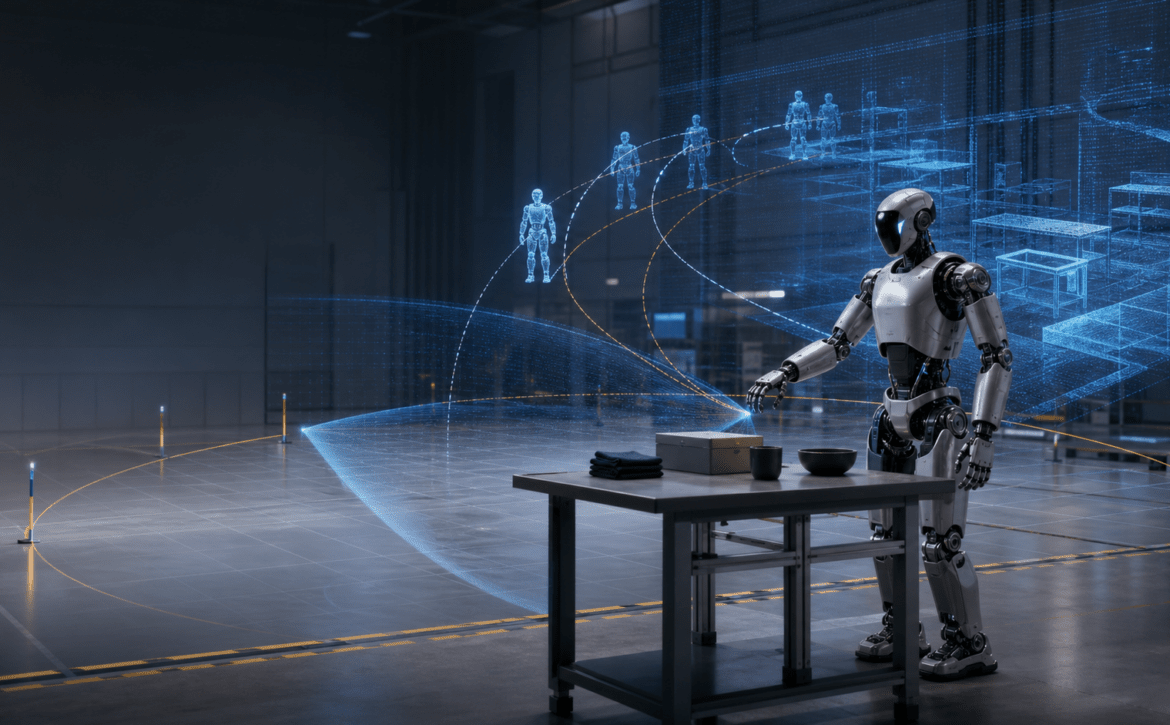
For most of robotics history, the intelligence in a robot was hand-coded. That era is closing astonishingly fast. Over the last two years, a new class of models has arrived that lets a legged humanoid or wheeled mobile manipulator see a scene, understand a spoken instruction, and generate commands for its actuators—often without task-specific programming. These are Vision-Language-Action models, and alongside them, a second idea—the world model—is reshaping how robots are being trained and validated.
If you lead a robotics program, you need a working mental model of both. In this article, our intention is to provide a concise overview, highlight the models worth knowing, and explain the safety challenge that comes with them.
From VLMs to VLAs: Adding Hands to the Eyes
A Vision-Language Model, or VLM, does two things: it takes in a combination of images and text, and it produces a text output. It can look at a kitchen counter and describe what it sees or answer a question about a scene. Powerful, but passive. It perceives and explains. It does not take action.
A Vision-Language-Action model, or VLA, adds this critical action component. It takes similar visual and text inputs and produces actions: joint movements, end-effector poses, gripper commands, or locomotion velocities for a wheeled base. In effect, a VLA bolts a motor cortex onto the reasoning capabilities of a VLM.
Some current VLAs use a two-part design that is easy to remember. A slower “reasoning” component, usually based on a pre-trained VLM, interprets the scene and the instruction provided by the user. A faster “control” component turns that scene interpretation into smooth, high-frequency motion commands. NVIDIA’s GR00T VLA describes this explicitly as System 2—the vision-language module—feeding System 1, a diffusion transformer that generates fluid motor actions in real time. The two components are tightly coupled and can be optimized together during post-training.
The property that makes VLAs interesting for a fleet, rather than a single robot, is cross-embodiment. Because some are trained on data spanning many machines—single arms, bimanual setups, wheeled mobile manipulators, and legged humanoids—a common base model may be adapted to a new body using additional robot- and task-specific data. That is a significant break from the one-robot, one-controller paradigm of the past.
World Models: Giving Robots an Imagination
A world model learns to predict what happens next in a physical scene. Give it the current view and, in some cases, a proposed action, and it generates a plausible future: the next frames or the next state. Some world models are interactive and action-conditioned, allowing the generated environment to respond to user or agent actions.
For humanoid robotics, this creates three important possibilities:
- Synthetic data generation: Rare or dangerous situations can be generated at scale rather than waiting for them to happen.
- Sim-to-real development: Visually realistic predicted environments can supplement physics-based simulators and help narrow the gap between simulation and the real world.
- Training and evaluation “in imagination”: An action policy can be rehearsed or stress tested against generated futures before it commands physical actuators.
At SRES, we have already seen related approaches in Automated Driving Systems (ADS), where organizations use world models and generative methods to create edge cases and expand scenario coverage.
The most consequential shift of the last two years is that capable robot foundation models are now available or under active development. To name just a few:
- GR00T, a VLA, and Cosmos, a family of world foundation models, from NVIDIA
- Gemini Robotics, a VLA, and Genie 3, a general-purpose world model, from Google DeepMind
- The π family of VLA models from Physical Intelligence
- Open research models including OpenVLA and Octo
These models differ in availability, openness, maturity, and intended use, but together they show how quickly the underlying technology is advancing.
The Part the Frameworks Are Still Catching Up To
As we have previously written in Beyond Standards: Why Humanoid Robot Safety Requires What No Framework Has Codified Yet, a VLA-driven robot can cause harm while operating as intended, with no hardware fault anywhere.
The VLA could simply produce the wrong action—and therefore the wrong actuation—for an out-of-distribution scenario. A glare off a warehouse window, an unfamiliar object geometry, or a fast-moving shadow interpreted as an obstacle could expose a limitation in perception or decision-making. This is a performance insufficiency, not necessarily a conventional fault, and traditional functional safety methods and standards were not designed to address the entire problem.
The emerging ISO/IEC TS 22440 series is being developed to address functional safety and AI systems, including the challenges introduced when AI is used in or around safety-related functions. Although the documents are still being drafted, there are practical engineering measures organizations can begin considering now.
Define the operating envelope, then test inside and outside it.
Specify the conditions for which the robot is designed and validated. Automated driving programs often formalize this through an Operational Design Domain, or ODD. Other robotics applications may use different terminology, but the underlying need is the same. Deliberately test at the edges and just beyond those conditions. Nominal scenario tests are not enough; corner cases and inputs outside the intended operating envelope are where unexpected behavior may emerge.
Detect out-of-distribution inputs at runtime.
When live inputs no longer resemble the data used during training and development, the VLA’s output should not be trusted blindly. Runtime out-of-distribution detection can help the system recognize when it is encountering unfamiliar conditions.
Quantify uncertainty and gate on it.
Treat model uncertainty as an important signal. When uncertainty is high, the system may need to fall back, slow down, or hand off rather than commit to an unsupported action. Confidence and uncertainty measures must themselves be evaluated and calibrated for the conditions in which they will be used.
Maintain a deterministic, non-AI safety fallback where appropriate.
A simpler, verifiable, rules-based layer—supported by measures such as hardware interlocks, speed and force limits, runtime monitors, or defined safe states—can help contain the AI controlled path when it behaves unexpectedly. The appropriate fallback depends on the system and hazard. For some mobile, balancing, or load carrying robots, an immediate shutdown may introduce a different risk.
Use diversity and voting for high stakes decisions where justified.
Independent and diverse models or channels, combined with an output voter, can reduce the chance that a single failure or edge case produces a harmful action. The claimed diversity must be genuine, however. Models that share training data, architectures, or assumptions may also share failure modes.
Monitor for drift.
Sensors age, environments change, and the relationship between an input and the correct output can shift over time. Continuous monitoring for data and concept drift can help identify gradual degradation that periodic testing may not reveal.
Many of these measures will be familiar to teams that have worked on automated driving systems. They reflect behavioral safety questions that arise in highly automated robotaxis, delivery robots, and long-haul trucks.
World model tooling may help considerably. Generated edge cases used to train a policy can also inform its validation suite. However, generated scenarios are not automatically credible safety evidence; teams still need to establish that they are representative of the conditions and claims being evaluated.
The Humanoid Race Won’t Be Won by Checking Boxes
VLAs and world models are giving robots a new kind of intelligence—one that can reason and generalize instead of relying entirely on rules-based code. That is exactly why the traditional safety assurance playbook is necessary but not sufficient.
A robot designed to do many different things can also encounter many different situations that challenge its assumptions. The companies that scale safely will be the ones that treat behavioral safety and AI assurance as design inputs from day one, layered on top of a strong functional safety and quality engineering foundation.
At SRES, our Physical AI safety framework is grounded in established functional safety foundations such as IEC 61508 and informed by the emerging AI safety methods being developed through the ISO/IEC TS 22440 series. We strengthen this framework with application-specific safety standards where available and draw on our experience developing safety-critical automated driving and autonomous systems.
🤖 Continue the Discussion During SRES Physical AI Safety Week
Explore these challenges in greater depth during SRES Physical AI Safety Week:
- September 14–16: IEC 61508 Functional Safety Training, with optional IFSP certificate exam
- September 17–18: ISO/IEC TS 22440 Functional Safety and AI Systems Training
Attend either course individually or join us for the complete week.
🔥 Watch the Full SRES Fireside Chat
Validation and Data in AI-Driven Systems
How can organizations build confidence in safety-critical systems whose behavior is learned from data? SRES partners Jody Nelson and Gokul Krithivasan joined Visage Technologies experts Drago Špoljarić and Ivan Peris to discuss validation, simulation, synthetic data, and assurance across automotive, autonomy, and Physical AI.
The complete fireside chat recording is now available.
🚘🤖 Upcoming Public Training Dates: ISO 8800, ISO 26262, IEC 61508, ISO/IEC TS 22440 & ISO 21448
ISO 8800, AI-Safety Professional (AISP) Training
📍August 19–21 or November 18–20 – This three-day certificate course equips participants to address the unique assurance challenges AI introduces in safety-critical automotive systems. It begins with foundational AI concepts, then builds toward how established automotive safety standards such as ISO 26262 and ISO 21448 can be supplemented by frameworks developed specifically for AI, including ISO/PAS 8800, ISO/TS 5083, ISO/IEC 42001, and ISO/IEC TR 5469.
Attendees have the option to take the AI-Safety Professional (AISP) certificate exam, accredited by SGS-TÜV Saar, following the course.
ISO 26262, Functional Safety Training
📍August 24–27 or October 19–22 – Gain a complete understanding of ISO 26262 and its practical application across the full automotive safety lifecycle. This four-day live virtual course, led by SRES automotive safety experts, combines real-world examples, exercises, and discussion to help teams build confidence in developing and assessing safety-critical systems.
Attendees have the option to take the Automotive Functional Safety Professional (AFSP) certificate exam, accredited by SGS-TÜV Saar, following the course.
IEC 61508, Functional Safety Training
📍September 14–16 – Gain a practical understanding of IEC 61508 and its application across the functional safety lifecycle for safety-critical electrical, electronic, and programmable electronic systems, including Physical AI. This three-day live virtual course covers hazard and risk analysis, safety requirements, systematic integrity, hardware and software development, FMEDA, common-cause failure, testing, and supporting processes.
Attendees have the option to take the Industrial Functional Safety Professional (IFSP) certificate exam, accredited by SGS-TÜV Saar, following the course.
ISO/IEC TS 22440, Functional Safety and AI Systems Training
📍September 17–18 – Explore the emerging approach to functional safety for AI systems and the additional challenges introduced by data-dependent and difficult-to-predict behavior. This two-day live virtual course examines the AI safety lifecycle, hazard and fault analysis, architectural mitigations, data quality, validation, runtime monitoring, and AI-based development tools. ISO/IEC TS 22440 remains under development, and the course content may evolve as the standard progresses.
ISO 21448, Safety Of The Intended Functionality (SOTIF) Training
📍September 22–24 – Learn how to apply ISO 21448 to identify functional insufficiencies, reduce unknown risks, and address hazards that can arise when a system is functioning as designed. This three-day live virtual course, led by SRES automotive safety experts, focuses on the practical application of SOTIF alongside ISO 26262 in the development of ADAS and automated systems.
Attendees have the option to take the SOTIF Professional (SOTIFPRO) certificate exam, accredited by SGS-TÜV Saar, during the final training day.
📘 Looking for a Different Kind of Training Support?
SRES also offers private and customized team training by request. Email us at info@sres.ai to discuss how we can support.
👉 View All Training Options 👉 Why Teams Choose SRES Training
💡 Latest SRES Insights
From UCAs to Test Scenarios: Building a Coherent Validation Pipeline for AVs
Learn how unsafe control actions can be refined into functional, logical, and concrete test scenarios to create a traceable validation pipeline for automated driving systems.
Comparing ISO/IEC TR 5469 and ISO/IEC TS 22440
Understand how ISO/IEC TR 5469’s foundational guidance compares with the more actionable engineering direction emerging through ISO/IEC TS 22440.
Quantitative Analysis for Multi-Point Failures
Explore simultaneous and ordered failures in redundant automotive architectures—and how the calculations inform ISO 26262 PMHF targets, diagnostic intervals, and service intervals.
Humanoid Robots in the Cybersecurity Era: The Impact of the EU Cyber Resilience Act
Learn how the EU Cyber Resilience Act applies to humanoid and industrial robots, including product scope, compliance deadlines, and manufacturer obligations.
Understanding ISO Standards: Development Process and Publication Types
Learn how ISO standards progress from proposal to publication and what the IS, PAS, TS, and TR designations mean.
Certificate vs. Certification in ISO 26262 Assessments and Audits: What You Need to Know
Understand the distinction between certificates and certifications, the role of ISO/IEC 17065 accreditation, and what organizations should evaluate when selecting assessment services.
Thank you for reading this August edition of SafeStack. We hope you enjoyed this month’s insights. If you found our technical content valuable, consider joining one of our upcoming public training courses, including SRES Physical AI Safety Week in September.
As always, you can follow us on LinkedIn to stay connected between issues. We look forward to continuing the conversation.