Understanding ISO Standards: Development Process and Publication Types
This article explains how ISO standards are developed, from the initial proposal through publication and review. It also explores the different ISO publication types—including International Standards (IS), Technical Specifications (TS), Publicly Available Specifications (PAS), and Technical Reports (TR)—and the role each plays in the standards development process. This article was written by a senior SRES safety expert with nearly 20 years of product development and functional safety leadership experience, including successful mass production launches and active involvement in international standardization groups.
Looking to go deeper? Explore SRES training programs, from TÜV certificate courses to advanced technical workshops tailored to automotive and Physical AI systems. Need more than training? Explore ourconsulting servicessupporting functional safety, robotics safety, cybersecurity, autonomous systems, EV development, and assurance of AI-based tools.
Introduction
ISO was founded in 1947 in London and spans standardization in many areas such as engineering, safety, transportation, energy, materials, food, but also standards supporting social aspects such as diversity and inclusion.
Although many people assume ISO is an acronym it is actually a name derived from the Greek word isos, meaning “equal.” The name reflects ISO’s mission of promoting consistency and facilitating international collaboration through globally recognized standards.
As you work with standards, you may encounter publications designated as IS, PAS, TR, TS, and others. What do these acronyms mean? Why do some standards seem to appear almost overnight, while others take many years until they are finally published?
The overarching question is: How are ISO standards created?
This blog provides an overview of the ISO standardization process, with particular emphasis on the different types of ISO publications, their purpose, and how they fit into the lifecycle of developing an international standard.
Building Consensus Takes Time
Unlike company specifications or industry guidelines, an International Standard represents the consensus of experts from around the world. Representatives from national standards bodies produce a document that can be adopted globally. Those representatives come from the industry, academia, government, and other stakeholders.
Consensus is valuable – it improves quality, encourages interoperability, and increases confidence that the standard reflects broad industry agreement. However, reaching that consensus requires multiple rounds of drafting, technical discussion, voting, and public review.
This is why developing an International Standard often takes three to five years, and sometimes even longer. ISO also provides alternative publication types that enable technical content to be published more quickly when there is an urgent market need, or the technology is still evolving.
Who Develops ISO Standards?
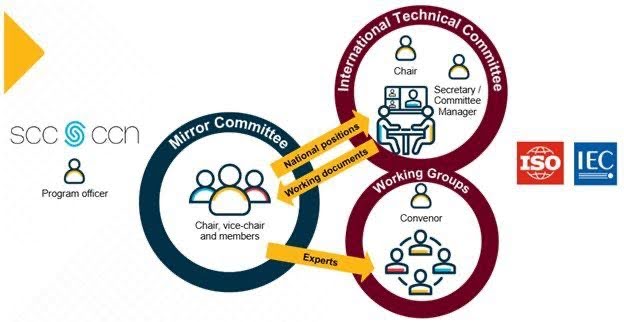
The primary contributors to ISO standards are experts nominated by their respective national standards bodies. Each participating country establishes mirror committees that review draft standards, develop national positions, and nominate experts to contribute to the work of ISO technical committees and working groups.
The ISO website provides an interactive world map that allows you to explore the national standards bodies representing each member country: https://www.iso.org/about/members
The following illustration shows the interaction with the example of the Standards Council of Canada (SCC) (in French: Conseil Canadien des Normes, CCN) as the national body.
ISO standards progress through a series of defined stages which are discussed in this section.
Each development stage is divided into substages that define specific milestones in the process. For simplicity, this blog focuses on the main stages and omits the substages.
Develop and mature an idea before formally proposing a new standards project.
Stage Exit
New Work Item Proposal (NP / NWIP) prepared for submission.
The Preliminary stage is the starting point of the standards development process. At this stage, a need for standardization has been identified, but no formal ISO project has yet been initiated.
Experts within the responsible technical committee or working group explore the problem to be solved, assess industry needs, evaluate existing standards, and determine whether international standardization would provide value. Initial technical concepts, scope, and stakeholder interest are discussed to establish a common understanding of the proposed work.
The outcome of the Preliminary stage is typically a sufficiently mature proposal that can be submitted as a New Work Item Proposal (NWIP) for committee approval, allowing the document to enter the Proposal stage.
Although stage 00 is defined in the ISO stage code system, not every standards project passes through it. Some projects begin directly at Stage 10 (Proposal) if the need and scope are already established.
Proposal Stage
Stage Code
10
Alternate Name
New Work Item Proposal (NP / NWIP)
Purpose
Confirm need for a new standard or revision.
Stage Exit
Approval or disapproval from national bodies. Experts must be nominated when voting “approve.”
A New Work Item Proposal (NP/NWIP) asks whether the technical committee believes a new standard should be developed. Member countries vote on the need of the project. If they approve, experts from the national body must be nominated as part of the vote. If approved, a working group is formed.
Preparatory Stage
Stage Code
20
Alternate Name
Working Draft (WD)
Purpose
A Working Group (WG) develops initial draft(s). Proceed if enough national bodies agree to proceed and participate.
Stage Exit
Initial Committee Draft.
The Working Draft is where most of the technical work happens.
Experts debate technical content, rewrite sections, resolve conflicting viewpoints, and gradually build consensus. Multiple Working Drafts are often produced before the committee feels the document is mature enough to move forward.
This stage typically consumes the largest portion of the project’s timeline.
Committee Stage
Stage Code
30
Alternate Name
Committee Draft stage (CD)
Purpose
Review and comments resolution.
Stage Exit
Initial Draft International Standard (DIS) at ISO, or a Committee Draft to Vote (CDV).
Once the working group has produced a sufficiently stable document, it becomes a Committee Draft (CD).
The draft is distributed to all participating national bodies for review and comment. Hundreds – or even thousands – of technical and editorial comments may be received, requiring careful review and resolution.
Some projects undergo multiple Committee Draft ballots before progressing.
The committee can vote to skip this step.
Enquiry Stage
Stage Code
40
Purpose
All national bodies vote on the DIS or CDV.
Stage Exit
Final Draft International Standard (FDIS).
After committee consensus has been achieved, the document advances to the Draft International Standard (DIS) stage.
The draft is now circulated to the broader ISO membership for formal voting and public comment. Technical changes are still possible, but the document is expected to be relatively mature.
Approval Stage
Stage Code
50
Purpose
All national bodies vote on the DIS or CDV.
Stage Exit
Approval vote.
At this point the emphasis is no longer on technical development but on confirming that the document is ready for publication. Member bodies cast a final approval vote. If there is further technical feedback at this stage, then the vote is required to disapprove for those to be incorporated into the standard.
Publication Stage
Stage Code
60
Purpose
Release the approved document as an ISO publication.
Stage Exit
Published ISO document.
Following successful approval, the committee secretary submits the final document to the ISO Central Secretariat (or IEC Central Office for IEC publications). After editorial processing and publication, the document becomes publicly available for purchase through ISO and the respective national standards bodies.
Publication marks the point at which the document becomes an official ISO publication and may be referenced by industry, regulators, customers, and certification bodies. Depending on the development path, the published document may be an International Standard (IS), Technical Specification (TS), Technical Report (TR), Publicly Available Specification (PAS), or another ISO publication type.
For International Standards, the “IS” designation is omitted from the document title. For example, ISO 26262 is an International Standard, referred to simply as “ISO 26262.”
Review Stage
Stage Code
90
Purpose
Determine whether the published document remains current and relevant.
Stage Exit
Confirm, revise, amend, or withdraw the publication.
ISO publications are periodically reviewed, at least every five years after publication, to ensure they continue to reflect current technology, industry practice, and stakeholder needs.
During the systematic review, the responsible technical committee decides whether the document should:
be confirmed without change,
be revised through a new development cycle,
be amended or corrected, or
be withdrawn if it is no longer needed or has become obsolete.
A decision to revise initiates a new standards development project while allowing the existing publication to remain valid until the revised edition is published.
Withdrawal Stage
Stage Code
95
Purpose
Remove a publication that is obsolete or no longer required.
Stage Exit
Publication withdrawn.
A document may be withdrawn when it has become obsolete, has been superseded by a newer edition or another standard, or is no longer considered relevant by the technical committee.
Once withdrawn, the publication is no longer maintained as an active ISO document and should generally not be used as the basis for new designs, contracts, or certifications. However, it may still be referenced for historical purposes or to support legacy systems developed while the document was in force.
Examples in Practice
Example 1: ISO 21448:2022
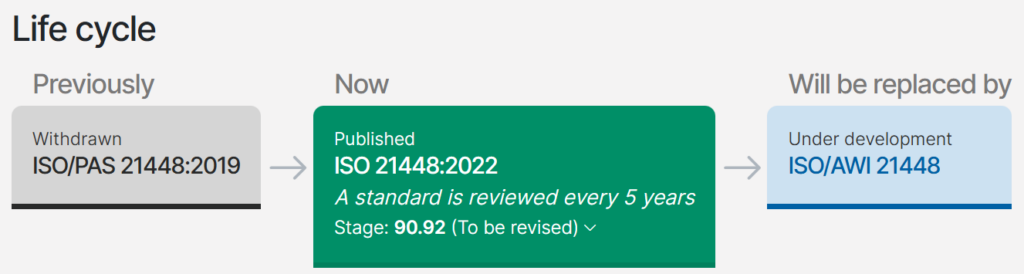
ISO 21448 is an International Standard published in 2022. Before becoming an International Standard (IS), it was initially published as a Publicly Available Specification (PAS). What exactly is a PAS? We’ll explain the different publication types shortly.
You can also see that the document’s current stage is 90.92.
The 90 denotes the Review stage, while 92 is the corresponding substage. As mentioned earlier, this blog focuses on the main development stages and does not cover the substages.
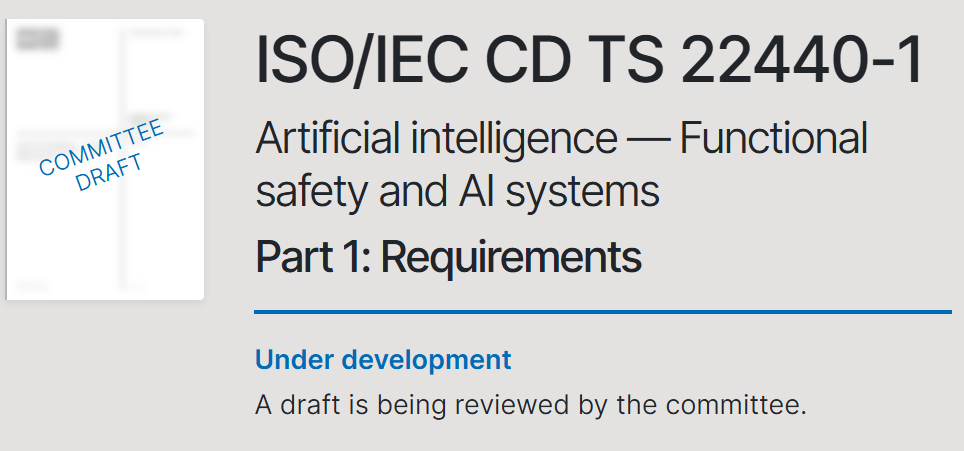
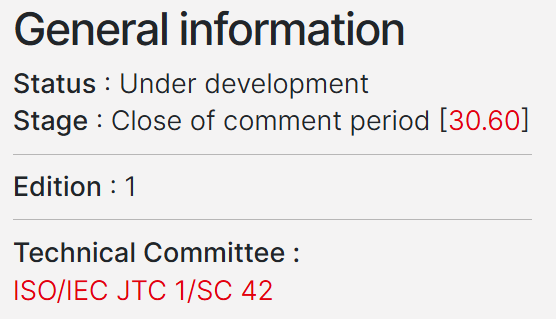
At the time of writing, ISO/IEC CD TS 22440-1 is currently under development.
Using the information presented above, we can immediately determine that:
CD stands for Committee Draft, indicating that the document is in the Committee stage of development and has reached a sufficiently mature level for review by the participating national committees.
ISO/IEC indicates that the document is being developed jointly by ISO and IEC.
But what does TS mean? The answer lies in the different ISO publication types, which we discuss next.
ISO Publication Types
Not every ISO document follows the full development path to become an International Standard (IS). While International Standards represent the highest level of international consensus, ISO provides several other publication types that allow guidance or technical specifications to be published more quickly.
The most common publication types are:
IS – International Standard
PAS – Publicly Available Specification
TS – Technical Specification
TR – Technical Report
Each serves a different purpose and follows a different approval process.
International Standard (IS)
An International Standard (IS) is the final and most authoritative type of ISO publication. It represents broad international consensus among the participating member countries.
Because multiple international ballots are required, development typically takes three to five years, although complex standards may take even longer.
International Standards are the documents most frequently referenced by regulators, certification bodies, customers, and contracts.
Publicly Available Specification (PAS)
A Publicly Available Specification (PAS) provides a mechanism for rapidly publishing technical requirements where there is an urgent market need.
Typical use cases include:
rapidly evolving technologies,
emerging industries,
pilot concepts requiring industry feedback.
Unlike an International Standard, a PAS is approved directly by the responsible technical committee and does not require the Enquiry (40) or Approval (50) ballots involving all ISO member bodies.
Typical development path:
Proposal → Preparatory → Committee → Publication
By skipping the international voting stages, a PAS can often be published within 6–18 months.
A PAS is temporary. It must be reviewed after 3 years of publication and may be:
converted into an International Standard,
revised,
extended, or
withdrawn.
Technical Specification (TS)
A Technical Specification (TS) is used when there is sufficient technical agreement to publish requirements, but not enough international consensus for an International Standard.
Typical reasons include:
technology is still evolving,
experience from implementation is needed,
consensus cannot yet be reached on all technical details.
A TS normally undergoes committee development but bypasses the Final Approval (50) stage required for an International Standard.
Development is therefore typically 1–3 years, making it significantly faster than an International Standard.
Many Technical Specifications eventually mature into full International Standards after additional implementation experience has been gained.
Technical Report (TR)
A Technical Report (TR) differs fundamentally from the other publication types because it contains information rather than normative requirements.
Technical Reports commonly include:
background information,
state-of-the-art surveys,
technical explanations,
implementation guidance,
examples and best practices.
Since a Technical Report does not establish requirements, it generally requires a simpler approval process and does not undergo the Enquiry (40) or Approval (50) voting stages.
Typical development path:
Proposal → Preparatory → Committee → Publication
Technical Reports can often be published within one to two years, depending on the complexity of the subject.
Because they are informative rather than normative, Technical Reports are not intended to be used for certification or demonstrating compliance.
Comparison of ISO Publication Types
Publication Type
Purpose
Normative
Typical Timeline
Development Stages
IS (International Standard)
International consensus standard intended for widespread adoption and certification
ISO development stages outlined in this blog describe the maturity of technical content and consensus, while accessibility is governed by distribution rules.
Early-stage documents such as Working Drafts (WD) and Committee Drafts (CD) are internal working materials used within technical committees and working groups. They are not publicly available and are restricted to registered experts and participating ISO members.
Later-stage documents such as DIS and FDIS are distributed for formal national review and voting but remain controlled-access documents rather than publicly sold publications.
Only once a document reaches the Publication stage does it become a published standard and commercially available for purchase and use by the public.
National, Regional, and Industry Standards Organizations
In addition to ISO, many other organizations develop standards at the national, regional, or industry level. These standards often complement ISO documents or serve as regulatory requirements within specific jurisdictions.
National Standards Bodies
Most countries have a national standards body responsible for developing and maintaining national standards. Examples include ANSI (USA), DIN (Germany), BSI (UK), and SCC/CCN (Canada).
As discussed earlier, these bodies participate in ISO through mirror committees.
A national standards body may develop its own standards by:
Adapting international standards with national deviations, or
Defining independent standards where no ISO equivalent exists.
Regional Standards Organizations
Regional bodies such as CEN and CENELEC harmonize standards across multiple countries in Europe. ISO standards are often adopted as EN ISO standards, meaning they apply both regionally and internationally. Conflicting national standards are typically withdrawn to ensure alignment.
Industry Standardization – Example: UL (Underwriters Laboratories)
Underwriters Laboratories (UL) is a US-based public company that develops widely used safety standards, particularly for electrical systems, fire safety, and industrial equipment.
UL standards are closely linked to certification. Compliance is often required to obtain a UL Listing Mark, which demonstrates that a product has been tested for safety.
Unlike ISO, UL standards are industry-driven and often tightly integrated with testing and certification processes. Common examples include UL 94 (Flammability of Plastics), UL 508A (Industrial Control Panels), and UL 1598 (Luminaires).
Final Thoughts
The ISO standardization process is intentionally rigorous. Multiple review stages ensure that technical documents represent broad international agreement and are suitable for long-term global adoption.
However, when technology advances faster than consensus can be achieved, alternative publication routes such as a PAS, TS, or TR provide an effective compromise. They enable industry to benefit from expert-developed guidance much sooner while leaving room for future refinement into a full International Standard.
Understanding these publication paths helps explain why some standards seem to take many years to appear, while others arrive much more quickly – not because the work is easier, but because the process has been adapted to meet the pace of innovation.
Have insights or questions? Send us an email at info@sres.ai or leave a comment below. We welcome thoughtful discussion from our technical community.