

Safety: The Invisible Margin, Part 1 — Why Safety’s Value is Invisible by Design
A series on seeing, pricing, and improving safety in autonomous robotics
This article was written by Gokul Krithivasan, Managing Partner and Co-Founder of SRES. Gokul is an SGS-TÜV Saar-certified Functional Safety Expert (ISO 26262), SOTIF Expert (ISO 21448), and Artificial Intelligence Safety Expert (ISO 8800) with more than 14 years of experience supporting autonomous and AI-enabled systems across automotive, autonomy, and robotics.
Looking to go deeper? SRES provides expert-led training for Physical AI systems, along with hands-on consulting support, including robotics safety, to help organizations develop and deploy Physical AI systems responsibly.
Series Introduction
Autonomous machines are moving out of the factory and into spaces full of ordinary people: warehouses, airport concourses, hospital corridors, and soon, living rooms. The engineering that keeps them from harming anyone in those spaces is some of the most consequential work in robotics, and it is also the hardest to see. When it succeeds, nothing happens. No incident, no headline, no line on a dashboard. That invisibility is the reason safety engineering is so often underfunded, and it is a business problem before it is a moral one.
This series is written for the people who decide where robotics budgets go. Its premise is simple: safety done well is invisible by design, and the companies that learn to make that invisible value legible, priced, and continuously improved will be the ones still shipping when the category faces its first serious test.
Over the next several pieces, we’ll work through three questions:
- Why is safety’s value so hard to see, even for leaders who genuinely want to fund it?
- Why is that blindness manageable in an industrial setting and consequential in a home?
- Why is the window to get ahead of it open right now, as humanoids begin arriving in real houses?
The approach throughout is practical and collaborative: a clearer way to see, price, and improve the work that keeps these machines trustworthy as they move closer to the people they serve. We begin with the most fundamental challenge: understanding why safety is so difficult to value in the first place.
You Can't See Safety's Value Because, by Design, There's Nothing to See
It is the year 2030. Picture autonomous floor scrubbers working at the world’s busiest airport concourses. For 12+ hours a day, each robot threads through rolling suitcases, distracted travelers, and children darting in unpredictable directions, and it touches none of them. That is the product of real safety engineering, and here is the strange part: no one will ever notice. Safety, done well, produces a non-event. No collision, no incident report, no viral video. Its entire output is an absence, and an absence is the one result that doesn’t show up in any system you use to allocate capital. There’s no demo for the near-miss that was quietly handled, and no metric moves when your team gets it right. Most other company functions you fund leave a trace: revenue, time to market, uptime, churn. Safety’s success looks identical to having done nothing at all.
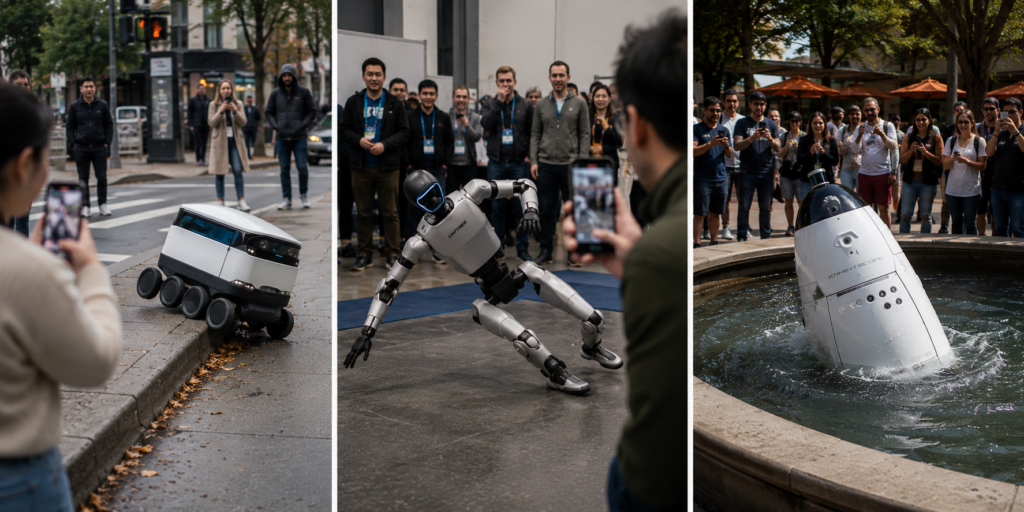
You can watch this asymmetry play out in public today. The only robot footage that circulates online is the robot failing: the delivery bot stranded at a curb, the humanoid losing its balance, the security robot tipped into a fountain. The thousands of uneventful hours that came before never get posted, because no one films a machine doing exactly what it should. The camera, like the budget, responds only to the failure. Both reward the rare bad moment and ignore the continuous good one.
This is worth saying plainly, because an underfunded safety function is easy to read as a sign that leadership doesn’t care enough. That’s rarely the real story. More often it’s a question of measurement. The discipline even has a name for the underlying issue: safety as a dynamic non-event, a result produced by continuous work that by definition can’t be observed or counted directly. If you’ve ever struggled to justify a safety budget you believed in, you weren’t being negligent. You were trying to price something the market hadn’t yet given you a price for.
When Safety Becomes a Victim of Its Own Success
This invisibility has a second-order effect worth naming, because once you see it you can manage it. When the work is invisible and failures are rare, every incident-free quarter quietly reads as evidence the spend was too high. The scrubbers have run flawlessly for eight months, so surely the safety validation can be trimmed for the next version of the robot to launch sooner and scale faster. The better the safety function performs on the current generation of robots, the more reasonable that looks. The incentive runs backward, not because anyone is careless, but because the signal itself rewards cutting. The encouraging part is that incentives are exactly the kind of thing good engineering organizations know how to fix, once they’re made explicit.
Researchers who study how complex systems behave over time, such as Sidney Dekker on drift and Diane Vaughan on the slow normalization of small deviations, describe a predictable pattern. Organizations don’t decide to become less safe. They re-baseline yesterday’s margin as today’s inefficiency, one defensible trim at a time. The useful thing about this pattern being predictable is that it is also engineerable. A team that knows drift is the default can build the feedback loops that catch it, which is really just continuous improvement applied to the one variable that doesn’t announce itself.
Making Safety Visible
So the honest starting point is a generous one: safety has been structurally hard to value, and that is a solvable problem. The teams that win the next decade of robotics won’t be the ones that fear the absence. They’ll be the ones who learn to make it visible, price it on purpose, and improve it deliberately. How to do that is the rest of this series. The first move is recognizing that whether a price signal exists at all is the entire difference between the scrubber in that airport and the humanoid butler in someone’s kitchen.
Have insights or questions? Send us an email at info@sres.ai or leave a comment below—we welcome thoughtful discussion from our technical community.
Interested in learning more about our approach? Explore why teams choose SRES training and how we help organizations with consulting support for physical AI applications.