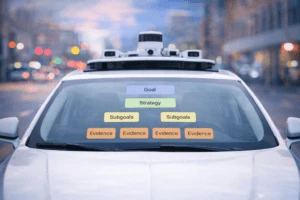

From Evidence to Argument: Using GSN to Structure AV Safety Cases
An introduction to Goal Structuring Notation (GSN) and how it helps autonomous vehicle teams build clear, defensible safety cases.

Technical standards and regulatory frameworks drive the reduction of functional safety risks across industrial and robotic systems. Organizations that establish proactive, robust functional safety programs—supported by well-trained development teams—gain a meaningful advantage while reducing liability and regulatory exposure as systems move into closer interaction with people.
SecuRESafe (SRES) experts have decades of hands-on experience developing, consulting on, and independently assessing complex, software-dominant safety-critical systems to meet the highest Safety Integrity Levels (SILs) under IEC 61508. Our work spans traditional industrial automation as well as mobile, autonomous delivery, and human-interactive robotic platforms.
As industrial systems evolve beyond fixed, fenced automation, functional safety concepts must be applied to robots operating in shared environments and respond dynamically to human presence. We help teams interpret and apply established functional safety principles in contexts where stability, controlled shutdown, and safe behavior under fault conditions are essential.
We also support compliance with evolving European regulatory frameworks, including the Machinery Directive and its replacement, the Machinery Regulation (EU) 2023/1230, which becomes mandatory in 2027. Safety obligations are addressed through applicable foundational standards such as ISO 13849 and IEC 62061, and increasingly through emerging robotics standards like ISO 25785, which builds upon these foundations for mobile, human-interactive robots. Unlike traditional industrial robot arms that can safely achieve a stop by cutting power, humanoid and mobile robots must often remain fail-operational—maintaining balance or executing controlled shutdown behaviors to avoid introducing new hazards—similar to expectations in autonomous vehicle systems.
What makes SRES unique is our proven track record supporting large-scale deployment of safety-critical automated and autonomous systems across industrial, on-road, and off-road applications. We understand how functional safety expectations evolve as autonomous capability increases—and we help organizations translate standards intent into credible, defensible safety arguments for modern robotic systems.
Let us know about your project and our team will be in contact

An introduction to Goal Structuring Notation (GSN) and how it helps autonomous vehicle teams build clear, defensible safety cases.


Observations from CES 2026 on humanoid robots, current safety strategies, and the gaps that emerge as robots move into shared human environments.

This article was written by an SRES functional safety expert and examines why software failures are treated as systematic—not random—under standards such as ISO 26262

We’re here to provide the guidance and support you need to navigate the complexities of engineering with responsibility and safety at the forefront.

info@sres.ai
How Can We Help You?